


In institutional multifamily investing, operational control is often the defining factor between durable performance and volatility. While market selection, underwriting discipline, and capital structure design are foundational, execution ultimately determines realized outcomes.
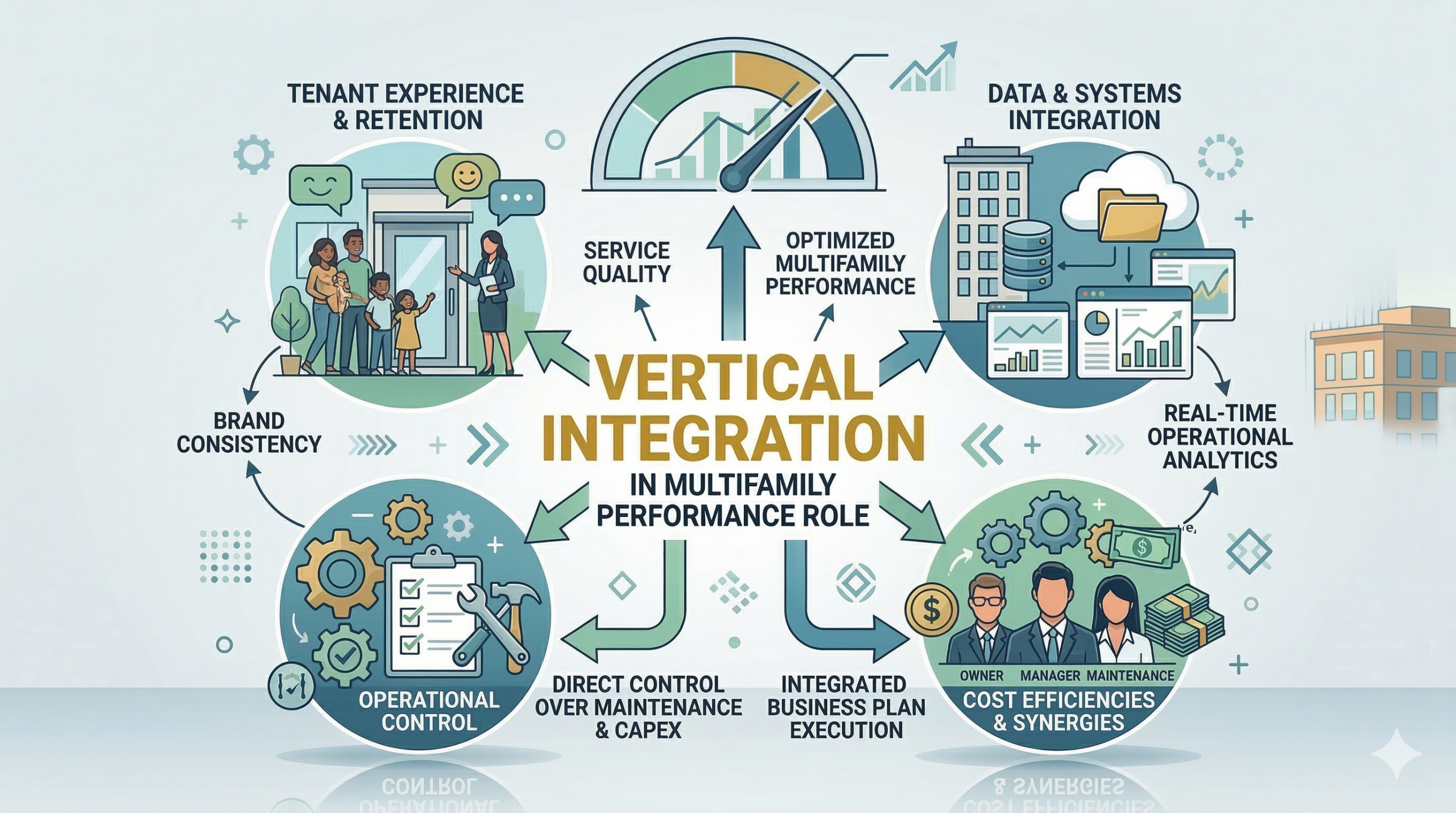
Vertical integration — where an operator controls key functions such as property management, construction oversight, asset management, and reporting — represents a structural advantage in today’s U.S. multifamily landscape.
Institutional investors increasingly favor vertically integrated platforms because they reduce execution risk, improve speed of decision-making, enhance cost discipline, and create greater alignment between ownership and operations.
In an environment defined by tighter liquidity, rising expenses, and operational complexity, vertical integration has transitioned from competitive advantage to risk mitigation necessity.
Vertical integration occurs when a sponsor directly manages multiple stages of the investment lifecycle rather than outsourcing critical functions.
These stages often include:
Rather than relying on third-party property managers or external construction teams, vertically integrated operators maintain internal teams responsible for performance execution.
This structural alignment enhances transparency and reduces dependency risk.
One of the primary institutional advantages of vertical integration is speed.
When property management and asset management operate within the same platform:
Third-party managers often introduce communication layers and incentive misalignment.
Execution delays increase holding costs and may erode projected returns.
Expense volatility has become a defining challenge in the multifamily sector.
Insurance premiums, labor costs, utilities, and maintenance expenses have experienced sustained upward pressure.
Vertically integrated operators can:
Small improvements in operating margin, when capitalized at prevailing cap rates, produce substantial valuation uplift.
Expense discipline compounds over multi-year hold periods.
Value-add strategies introduce additional operational complexity.
Internal construction teams enable:
Construction cost overruns and delays represent common sources of IRR impairment.
Institutional sponsors mitigate these risks through structured oversight and contingency budgeting.
In third-party management arrangements, incentives may not fully align with ownership objectives.
Vertically integrated platforms align:
Alignment reduces agency risk and improves performance transparency.
Institutional allocators favor sponsors with unified operational accountability.
Operational discipline becomes most critical during contractionary cycles.
During economic stress, vertically integrated operators can:
Third-party managers may be slower to respond or less incentivized to prioritize cost containment.
Integrated oversight reduces drawdown severity.
Institutional investors prioritize transparency.
Vertically integrated platforms often utilize:
This enables early identification of performance drift and faster corrective action.
Accurate reporting enhances lender confidence and supports refinance negotiations.
Operational consistency enhances exit credibility.
Buyers conducting due diligence evaluate:
Well-documented, internally managed assets often command stronger buyer confidence.
Liquidity resilience improves when operational systems are institutionalized.
While vertical integration offers advantages, it also introduces internal complexity.
Risks may include:
Institutional investors evaluate whether sponsors possess sufficient scale and organizational depth to support integrated operations effectively.
Integration without scale may introduce inefficiency rather than advantage.
Vertically integrated operators often demonstrate:
These characteristics reduce return volatility and enhance long-term compounding.
Institutional allocators frequently allocate repeat capital to sponsors demonstrating operational control and consistency.
Passive investors evaluating multifamily sponsors should examine:
Vertical integration, when executed effectively, enhances performance durability and risk control.
However, integration must be supported by organizational infrastructure and disciplined governance.
It refers to controlling multiple operational stages — including property management and construction — within a single sponsor platform.
Yes, when executed effectively. It enhances operational control, cost discipline, and execution speed.
Because operational alignment reduces agency risk and enhances performance predictability.
Potentially, but sufficient scale and infrastructure are necessary to avoid inefficiencies.
In today’s multifamily environment, operational complexity and expense volatility require disciplined oversight. Vertical integration provides structural advantages in execution speed, cost control, alignment, and risk mitigation.
Institutional investors recognize that market cycles are inevitable, but operational discipline remains controllable. Sponsors who integrate key functions internally often demonstrate greater resilience, stronger NOI stability, and enhanced long-term capital preservation.
In an increasingly selective capital environment, vertical integration is not simply a differentiator — it is a defining feature of institutional-grade multifamily platforms.

